
Resolutions To Property Disputes in Queens, NY
Resolving Residential Property Disputes in Queens, NY: Negotiation to Litigation
When Queens homeowners, co-op shareholders, and neighbors find themselves embroiled in residential property disputes, understanding your legal options can make the difference between a swift resolution and a costly, drawn-out battle. At Simon & Gilman, LLP, we help clients navigate the complete spectrum of resolution methods—from efficient, collaborative negotiation to aggressive litigation—to find the fastest, most favorable outcome for your Queens property.
Not every property dispute requires a lengthy court battle. Our experienced Property Dispute Lawyer Queens, NY team evaluates each case to determine the most effective path forward, whether that's direct settlement negotiations or full-scale litigation in Queens County Supreme Court.
The Spectrum of Resolution: From Collaborative to Judicial
Property dispute resolution falls into three primary categories, each offering distinct advantages depending on your specific circumstances:
- Direct Negotiation - Fastest and most cost-effective approach
- Mediation - Assisted resolution with neutral third-party facilitation
- Arbitration - Binding private court decision
- Litigation - Court-ordered, public judicial resolution
Understanding these options empowers Queens property owners to make informed decisions about protecting their real estate investments and resolving conflicts efficiently.
Resolving Conflicts Outside of Queens Court
Attorney-Led Negotiation (Direct Settlement)
Our residential real estate attorney team begins most disputes with direct negotiation, where attorneys exchange settlement offers and legal arguments on behalf of their clients to reach mutually acceptable agreements. This process works exceptionally well for boundary disputes where survey lines are clear, or simple disagreements over shared maintenance costs between neighbors.
The outcome is a formal, legally binding Settlement Agreement that resolves the dispute without court involvement. For Queens property owners dealing with straightforward conflicts, this approach often saves both time and money while preserving neighborly relationships.
Mediation (Facilitated Agreement)
When direct negotiation reaches an impasse, mediation offers a structured alternative. A neutral third-party mediator—often a retired judge or experienced attorney—facilitates discussions to help parties find common ground. Importantly, the mediator does not make decisions but guides the conversation toward resolution.
Queens residents benefit from both community and private mediation services that can save significant court time and costs. This confidential process often preserves relationships between neighbors, co-op shareholders, or family members involved in property disputes.
Arbitration (Binding Decision)
For disputes requiring definitive resolution, arbitration provides a private court setting where parties present their cases to an arbitrator who issues a final, binding decision called an Award. This process is frequently mandated by co-op proprietary leases or condo bylaws for internal disputes.
The primary benefit of arbitration is speed—decisions typically come faster than trials, and the arbitrator's ruling is final and enforceable, offering quick certainty for all parties involved.
Court Remedies: When Litigation is Necessary
Filing Suit in Queens County
When alternative resolution methods fail or aren't appropriate, our residential real estate lawyer in Queens team files lawsuits in Queens County Supreme Court for complex property rights issues involving title disputes or partition actions, or in Queens Civil Court for monetary damages.
Common Judicial Remedies in Property Disputes
- Injunctions: Court orders compelling parties to take specific actions (such as removing an encroaching fence) or stop certain behaviors (like blocking an easement). These remedies are crucial for resolving neighbor disputes involving property boundaries or shared access rights.
- Specific Performance: Courts order parties to fulfill contractual obligations, such as completing a transaction under a purchase agreement. This remedy ensures that valid real estate contracts are honored.
- Declaratory Judgment (Quiet Title): Courts declare the legal rights and interests of parties in property, definitively resolving ownership questions. This is essential for adverse possession claims or complex title issues affecting Queens properties.
- Partition Judgment: For co-owned properties, courts can order either physical division (rare in NYC) or property sale with proceeds divided among owners (most common). This resolves disputes between family members or business partners who cannot agree on property management.
- Damages: Monetary compensation for financial harm caused by disputes, including loss of rental income, repair costs, or diminished property values.
The Trial Process in Queens Supreme Court
Litigation proceeds through several phases: Discovery (gathering evidence), Motion Practice (legal arguments), Pre-Trial Conferences (settlement discussions), and Trial (presenting evidence to a judge or jury). Our team prepares every case for trial, which positions clients for stronger settlement negotiations throughout the process.
Laws Guiding Queens Property Dispute Outcomes
Key New York Legal Principles
- Statute of Frauds: Property agreements must be in writing to be legally enforceable, protecting parties from fraudulent claims and ensuring contract clarity.
- Adverse Possession (RPAPL): New York's 10-year requirement for boundary and title claims means that continuous, open, and notorious possession of property for a decade can establish ownership rights.
- Rule of Reasonableness: Courts judge co-op and condo board decisions by whether they are reasonable and within the board's authority, providing important protections for shareholders and unit owners.
These legal principles guide how Queens courts resolve property disputes and inform our strategic approach to each case.
Why Timing is Critical in Real Estate Disputes
Property disputes are subject to strict time limitations under New York law. The 10-year statute of limitations for adverse possession and title claims means that waiting too long can eliminate legal options. Other property-related claims may have shorter limitation periods.
Don't delay seeking legal advice—contact our Queens office at 332-264-7559 immediately to have your documents reviewed and understand your rights. Early intervention often leads to better outcomes and more resolution options.
Frequently Asked Questions About Queens Property Disputes
What types of property disputes are most common in Queens?
The most frequent disputes involve boundary disagreements between neighbors, co-op and condo board conflicts, landlord-tenant issues, contract breaches during property sales, and partition actions among family members or business partners who co-own property.
How long do property disputes typically take to resolve?
Resolution timeframes vary significantly based on complexity and chosen method. Direct negotiation may resolve disputes in weeks, mediation often takes 1-3 months, while litigation can extend 12-24 months or longer for complex cases involving multiple parties or significant assets.
Can property disputes affect my ability to sell my home?
Yes, unresolved property disputes can create title issues, boundary uncertainties, or legal clouds that make properties difficult or impossible to sell. Resolving disputes promptly protects your property's marketability and value.
What should I do if my neighbor is encroaching on my property?
Document the encroachment with photographs and surveys, review your deed and property records, and contact our office immediately. Early legal intervention can often resolve boundary disputes through negotiation before they escalate to expensive litigation.
Are there alternatives to going to court for co-op or condo disputes?
Many co-op and condo bylaws require mediation or arbitration before litigation. These alternative dispute resolution methods are often faster and less expensive than court proceedings while still providing binding resolutions.
Take Action to Protect Your Property Rights Today
Whether you seek quiet mediation or full-scale litigation, our Queens real estate attorneys are ready to protect your property rights and achieve favorable outcomes. We understand the local courts, judges, and legal landscape that affects property disputes throughout Queens neighborhoods from Astoria to Jamaica.
Our comprehensive approach combines decades of experience with personalized attention to each client's unique circumstances. We've successfully resolved property disputes involving everything from simple boundary disagreements to complex multi-party litigation worth millions of dollars.
Contact us for a free consultation to discuss your property dispute and explore your legal options. Call 332-264-7559 today to schedule your strategic consultation with Simon & Gilman, LLP—your trusted partner for Queens residential property dispute resolution.
Contact Us
For a FREE Appointment
Contact us online or call us at 332-264-7559 to schedule a free consultation with one of our attorneys — one of whom speaks Spanish.
Contact Us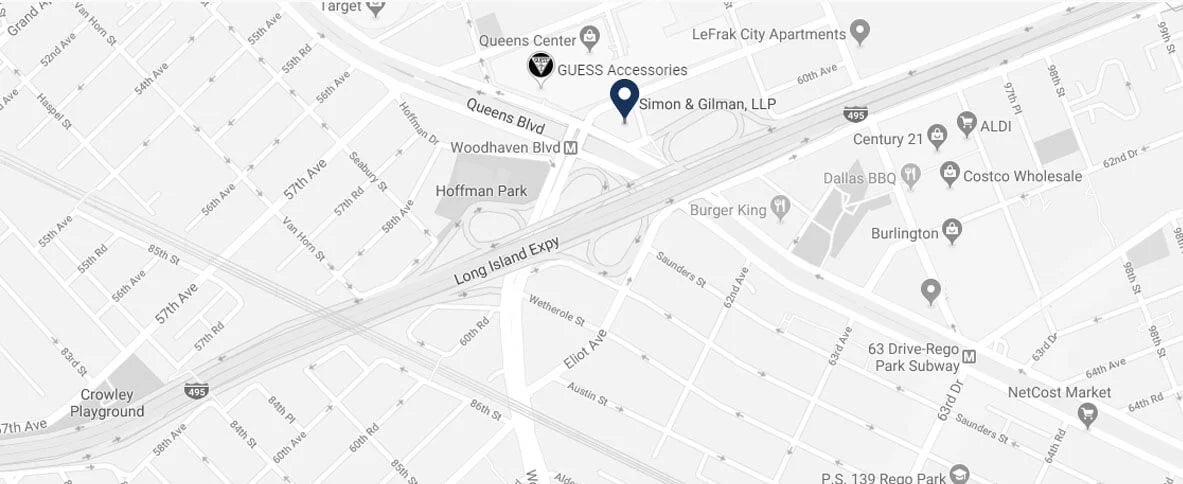
Simon & Gilman, LLP
Contact The Office
91-31 Queens Boulevard, Suite 411
Queens, NY, 11373